
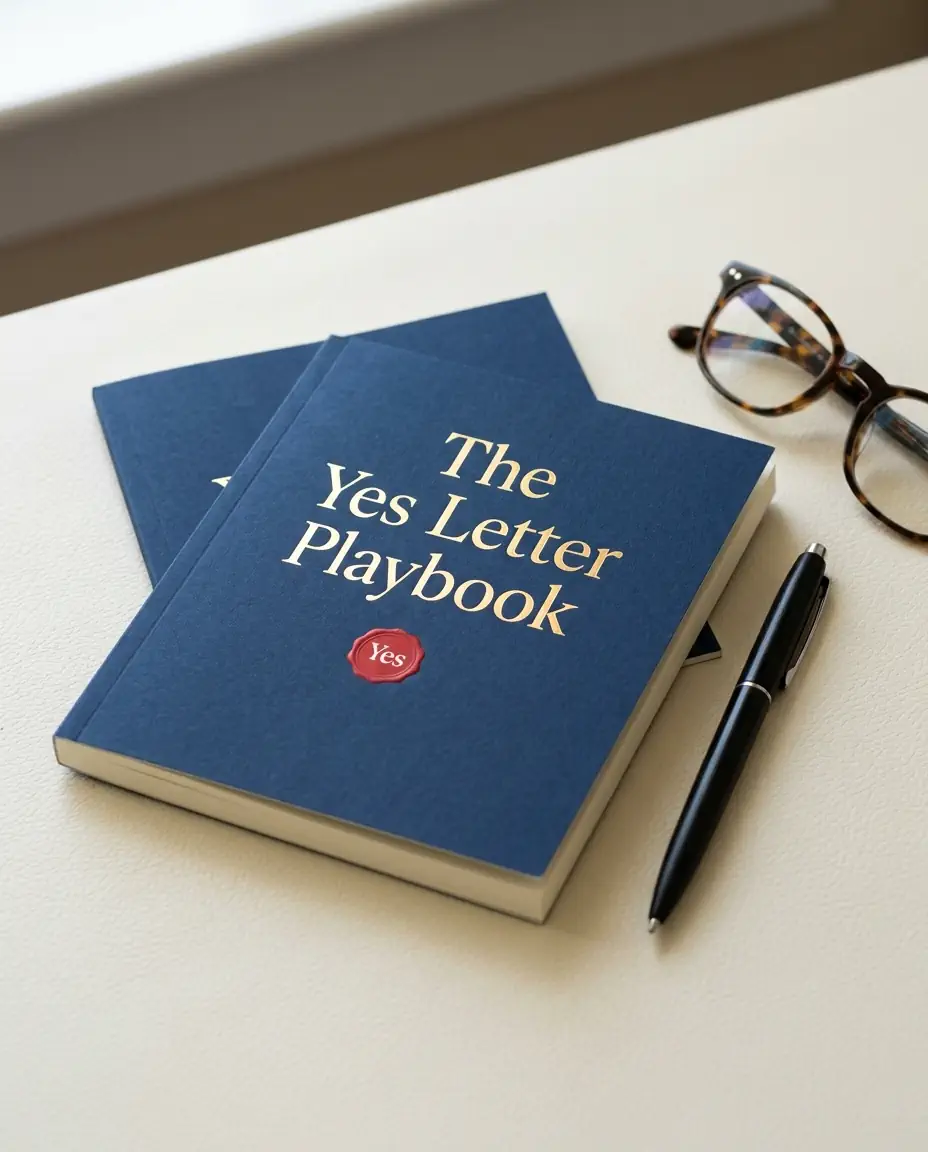
The Yes Letter Playbook

Get your student through college applications with a clear plan, without paying $6,500
The step-by-step playbook for parents: the college list, the early strategy, the essays and every deadline, in the right order.
The problem
Five weeks before Nov 1, most families are still guessing
Which schools belong on the list? Early Decision or Early Action? Is the essay on track? Did anyone ask the teachers yet?
Every website says something different, and the school counselor has 400 other students.
So the questions pile up at dinner. Your student gets tense. You wonder if you should hire a consultant, then see the price.
The real reason
Great students get rejected because of the process, not the grades
Every spring, strong students open disappointing letters. It's rarely about talent.
It's usually three things: a list built from rankings, an Early Decision chosen by gut feeling, and an essay written the weekend before the deadline.
Admissions feels chaotic, but it's really a sequence of twelve steps. Get the order right and the stress drops.
The solution
The method a $6,500 consultant follows, written for parents
Private admissions consultants charge families about $6,500 on average. Most of what they do follows a method, built on public data any parent can read.
The Yes Letter Playbook puts that method in your hands, step by step. You run the calendar. Your student does the writing. Nobody gets lost.
How it works
Three moves that turn chaos into a calendar
Build the list. Ten minutes per college with the Common Data Set, and every school sorted into reach, target or likely.
Choose the strategy. Early Decision, Early Action or Regular, decided school by school with a clear test.
Run the weekly check-in. Twenty minutes, same time every week, until May 1.
You become the project manager, not the author. Admissions officers want your student's voice. Your job is the structure around it.

Is it for you?
✅ It's for you if
Your student is a senior applying this fall, or a junior getting ahead.
You want a clear plan without paying thousands.
You'd rather have a system than another opinion.
❌ It's not for you if
You want someone to write the essays for your student.
You're looking for a guarantee of admission.
You already work with a full-time private consultant.
Timing
Early deadlines are close, and this week counts
Many Early Decision and Early Action deadlines fall on November 1 or November 15. By now, seniors applying early should have a final list, confirmed recommenders and a first draft of the personal statement.
If that's not where you are, the playbook shows you exactly how to catch up.
Get started
Download the playbook and start tonight
Instant PDF download, 25 pages, 2026–27 edition. Add the Deadline Calendar at checkout to get every key date in your phone with automatic reminders.
Questions
Your questions, answered
Is a $27 guide really enough?
It won't replace a consultant's time with your family. It gives you the method they use: the list, the strategy, the calendar and the checklists. Most families need the method more than the meetings.
My student will handle it anyway. Why do I need this?
Your student writes. You keep the calendar, the budget and the check-ins. The playbook shows each of you exactly what to own, so fewer things fall through the cracks and fewer arguments start.
Is it up to date?
Yes. It's the 2026–27 edition, written in September 2026. Every date is marked as typical, and the playbook shows you how to confirm each one on the college's own site.
Do you write or edit essays?
No. Colleges expect the student's own work. The playbook shows how to choose a prompt, plan the essay and give feedback without rewriting it.
Is it useful for juniors?
Yes. Juniors can build the list, plan testing, pick recommenders and draft the essay in summer, which puts them months ahead.
Does it guarantee admission?
No one can honestly guarantee admission. A clear plan does help your student end up with a list full of good options in April.